Painting Details
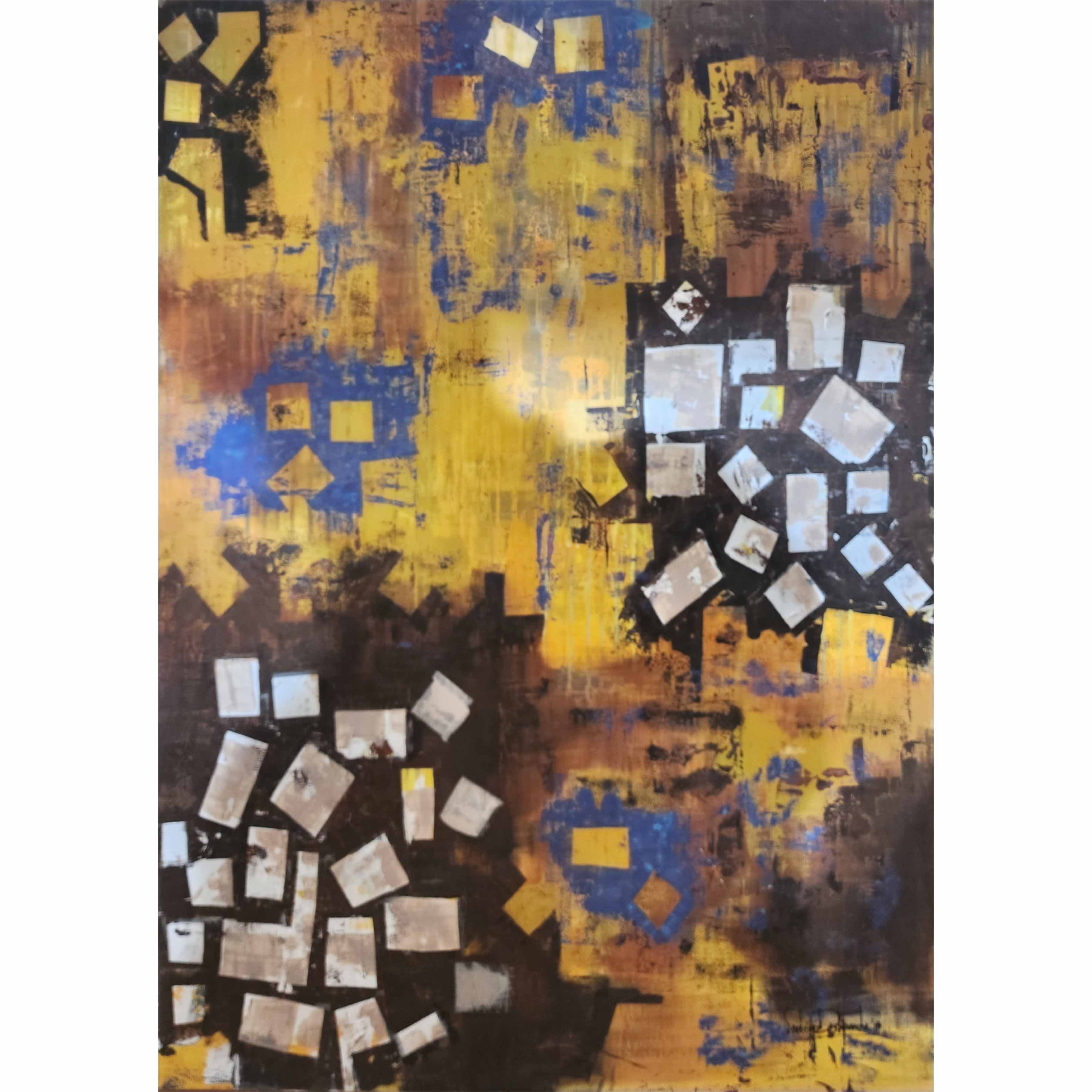
"Separation"
This is an abstract work by Sudeep Deshpande, a Bahrain-based architect and artist. It reflects his "Geometry of a Mood" philosophy, where emotions are translated into structured shapes.
Inquire about this painting
This painting is a striking example of the signature style of Sudeep Deshpande, a Bahrain-based architect, sculptor, and abstract artist. Known for translating complex human emotions into geometric forms, Deshpande's work often explores the "geometry of a mood."
Key Details & Artistic Style
Medium & Technique: The piece likely uses acrylics and charcoal on canvas. Deshpande is known for his "sequence of application"—a process of dripping paint, sponging it to create depth, and then using a palette knife to overlap textures.
Symbolism of Shapes: The recurring squares and rectangles are a hallmark of his work. He uses these geometric forms to represent the "framed" or rigid nature of certain life situations. In his philosophy, every emotion has its own mass, lines, and space.
Color Palette: The contrast between the vibrant golds/yellows and the dark, earthy browns and blacks is intentional. In his similar works (like the Separation series), he uses:
Yellows/Golds: To represent vibrant bonds or energy that remains "alive" even in difficult times.
Blacks/Darks: To represent finality, boundaries, or the "grey times" people navigate.
Blue Accents: Often signify depth or a specific emotional "pocket" within the broader composition.
Thematic Context
Deshpande’s work is deeply influenced by his background in architecture. He views relationships and emotions as structures that can be "unlayered." This specific painting likely belongs to a collection exploring human attachment and the dynamic between individuals and society.
The scattered, overlapping nature of the squares suggests fragmentation or "patch-ups"—a theme he frequently explores using paper and canvas to show the fragile nature of compromises in relationships.
"I believe that emotions, moods, and thoughts have their own geometry, their own lines, their own mass, and their own space." — Sudeep Deshpande